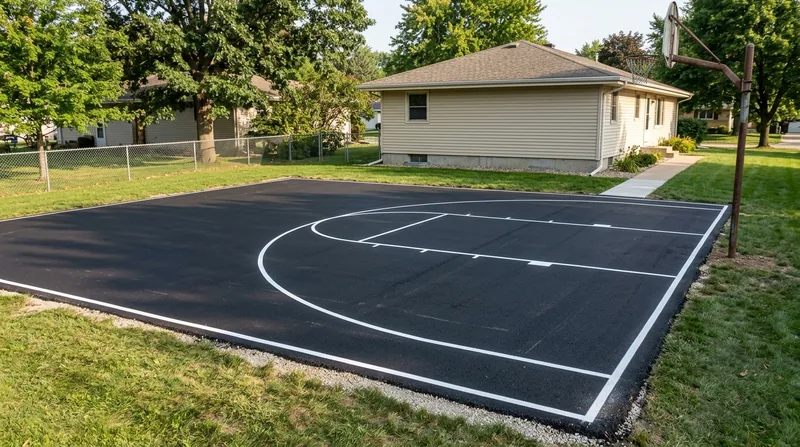




Appleton's Fox Valley climate delivers a Sports Court & Path Paving challenge that most contractors misunderstand. The silty clay loam and glacial till beneath the Riverside Historic District, the university blocks, and the post-war ranch ring all heave and shift through winters that push the frost line deep into the ground. A backyard basketball court, tennis court, or walking path built on clay without a proper engineered base will crack, settle unevenly, and fail within two or three seasons. We grade and compact a stable base, then finish with hot mix asphalt that stays flat through the Fox Valley freeze-thaw cycle, so your court plays true and your paths stay safe year after year. Since 2011, we have built courts and paths across Appleton, Neenah, Menasha, and Kaukauna that hold their surface through the hard winters and heavy spring thaws this region demands.
Why Proper Base Preparation Matters for Courts and Paths in Appleton
A flat, playable court surface begins underground. Appleton sits on clay and loam that expands and contracts with the freeze-thaw cycle, and without a properly compacted base, that movement cracks asphalt within the first winter. The base layer must be stable, well-draining, and thick enough to distribute the weight and motion of play across the soil beneath. We grade to slope for drainage, compact the subgrade, and build a crushed stone base that resists heave. Only then does the hot mix asphalt go down, and only then does the court stay flat.
- We grade the site to ensure water drains away from the court and paths, not toward them.
- We compact the native soil and proof-roll the subgrade to confirm it is stable before we add stone.
- We lay a compacted crushed stone base thick enough to handle frost heave and distribute play loads evenly.
- We finish with hot mix asphalt at the thickness your court or path needs to stay playable through Appleton winters.
This discipline is what separates a court that lasts from one that fails in its first hard freeze.
Local example: A residential court in Appleton near the Riverside Historic District failed after three years because the contractor skipped the base prep and poured asphalt directly on clay. We removed the failed surface, built a proper base, and installed new asphalt. The court now plays flat through every spring thaw. Proper base work costs more upfront, but it is the only way to build a court that lasts in this climate. See our gravel driveway installation and grading service for more on base preparation techniques we use across all paving projects.
How We Build a Sports Court or Path in Appleton: Step by Step
Every court and path job starts with a site visit and a measurement. We look at the soil, the drainage, the frost line depth, and the space you have. We give you a written estimate that names the tonnage of stone base, the thickness of asphalt, and the timeline. Then we execute the work in order, with no shortcuts.
- We stake the site and mark the layout so the court or path is square and at the right elevation.
- We excavate or grade to remove soft soil and establish a stable subgrade, then proof-roll it to confirm it is firm.
- We haul and spread compacted crushed stone base material to the depth specified in the estimate, then compact it with a vibratory roller.
- We sweep the base clean and lay hot mix asphalt at the thickness required, then finish it smooth and level.
- We allow the asphalt to cure before you use the court or path, typically within 24 to 48 hours in warm weather.
The entire process takes one to three days for a typical residential court, depending on site prep and weather.
Appleton example: A family in Fox Crossing wanted a half-court basketball court in their backyard. The site was clay and sloped toward the house. We graded it to slope away, built an 8-inch compacted stone base, and finished with 2 inches of hot mix. The court is now level, drains properly, and has withstood three winters without cracking. The entire project took two days and cost within the estimate we provided on the first visit.
Court and Path Paving Methods in the Fox Valley
| Approach | Description | Best for |
|---|---|---|
| Full-depth hot mix asphalt | Excavate to subgrade, compact base, install 3 to 4 inches of hot mix asphalt on a stable stone foundation. | New courts and paths where soil is unstable or clay heave is a concern (the standard for Appleton). |
| Asphalt over existing stable base | If an old court has a good base but a failing surface, we remove the top layer and repave with new hot mix. | Resurfacing an older court where the base is still sound and not heaving. |
| Tar and chip or recycled asphalt | A lower-cost alternative using recycled asphalt millings and a binder, rolled and compacted. | Walking paths and informal play areas where a softer, more rustic surface is acceptable. |
| Grading and base prep only | We prepare the site, compact the base, and you choose your finish material or hire another contractor for paving. | Homeowners who want to phase the project or use a specialized court surfacing contractor. |
Hot mix asphalt is the standard for basketball and tennis courts in Appleton because it holds its shape, drains properly, and stands up to the freeze-thaw cycle. Recycled asphalt and tar-chip work well for walking paths and informal play areas.
Sports Court and Path Paving Cost in Appleton: What to Expect
A residential basketball or tennis court in Appleton typically starts at $8,500 and moves higher based on site conditions, court size, and base requirements. A 30-by-30-foot half-court with a proper stone base and 3 inches of hot mix will run in that range. Walking paths are less expensive per square foot because they do not need the same thickness or precision leveling as a court. The largest cost drivers are the depth and stability of the base, the thickness of asphalt, and the site prep work required to handle clay and heave.
Appleton's clay subgrade often means more excavation and base material than a sandy site would need. If your site has poor drainage or soft soil, the base cost will be higher. We provide a written estimate with tonnage and thickness specifications after a site visit, so you know exactly what you are paying for. We recommend getting two or three estimates from local contractors so you can compare methods and pricing. The cheapest estimate is often the one that skips the base work, and that is the court that fails in the first winter.
For a detailed pricing breakdown and to discuss your specific court or path project, see our full pricing overview or call us at (920) 949-8579 for a free estimate.
Sports Court and Path Paving Near Me: What Appleton Homeowners Should Know When Hiring a Contractor
A court or path is a significant investment, and choosing the right contractor matters. Look for a local company that can show you examples of courts they have built in Appleton or the surrounding Fox Valley, and ask for references you can actually call. Verify that the contractor is fully insured and carries liability coverage, because accidents during site prep or paving can be expensive. Get multiple written estimates that include the base material, asphalt thickness, and tonnage, so you understand what each contractor is proposing.
Check whether your property is in an HOA or a historic district, because some communities have architectural standards or drainage rules that affect how you can build a court or path. If your project touches the property line, involves a culvert, or changes drainage, your city may require a permit. Appleton's building department can tell you what is required, and an honest contractor will help you navigate that process rather than promise to handle it all. Be wary of unsolicited door-to-door offers, contractors without a local address, or bids that seem too low to include proper base work. The single strongest signal of a reputable contractor is a written estimate with tonnage, a local address, and local references.
When you are ready to move forward, contact us for a free estimate. We have been serving Appleton since 2011, and we build courts and paths that last.
Sports Court & Path Paving in Appleton: Pricing Guide
| Service | Price | Details |
|---|---|---|
| Half-court basketball or small tennis court | Starting at $8,500 | Includes site grading, compacted stone base, and 3 inches of hot mix asphalt, sized for typical residential space |
| Full-size tennis court or large basketball court | Starting at $12,000 | Larger footprint, deeper base for clay subgrade, proper drainage slope, and finished hot mix asphalt surface |
| Walking path or informal play area | Starting at $4,500 | Grading, compacted base, and asphalt or tar-chip finish, priced per linear foot and width of path |
| Site prep and base only, no asphalt | On estimate | Grading, excavation, and compacted stone base without finish paving, allowing phased construction or other surfacing |
| Travel and estimate | Free | No charge for site visit and written estimate with tonnage and thickness specs, response within 24 hours |
Indicative pricing, the exact cost depends on square footage, finish, and site access. Free personalized estimate within 24h at (920) 949-8579.


